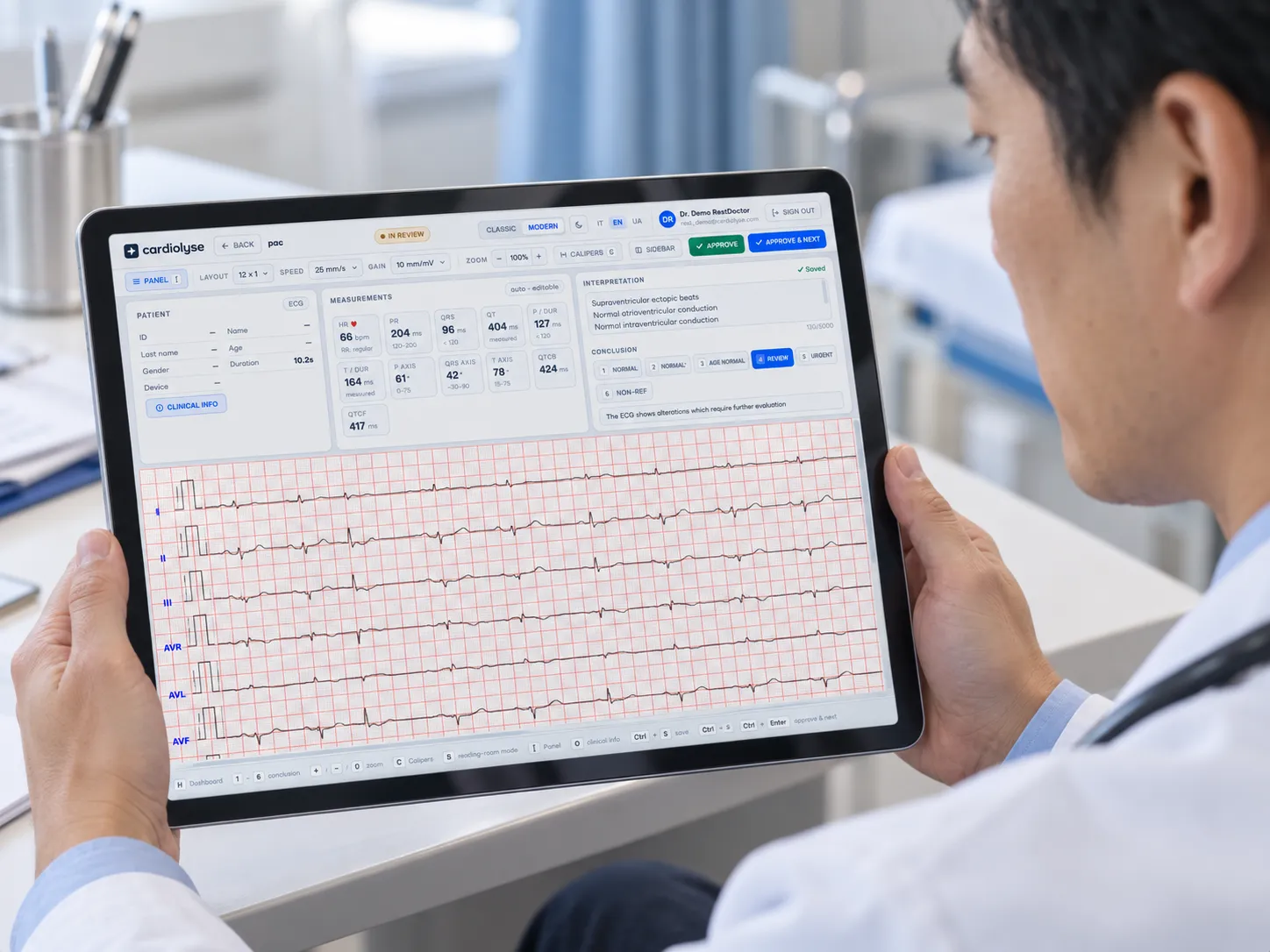
No extra recording and no extra hardware. From the ECG you already capture, Cardiolyse derives more than 30 heart rate variability metrics, ECG codes and scores — from autonomic balance and stress to Heart Biological Age.

Each score is calculated from the same ECG signal as the rhythm and interval analysis, using a short recording window.
We state what evidence exists for each score today. Cardiolyse-branded validation of the HRV-based scores continues as further studies conclude.

Capture an ECG / PPG — a short single-lead recording is enough. HRV-based scores use a 30–180-second window.
Send the signal through the REST API or a partner integration.
HRV metrics, ECG codes and scores are calculated from the same signal as the standard ECG analysis.
Values return as structured data, ready to show in your platform and to track over time.
No. Scores and HRV metrics are calculated from the same ECG signal used for the standard analysis. RoHD uses a 30-second window; the HRV-based scores use a 180-second window.
Yes. The scores and HRV metrics are designed to work from a short single-lead ECG, so they suit handheld devices, patches and wearables as well as standard ECG recorders.
More than 30 in total: 21 HRV metrics (such as SDNN, RMSSD, pNN50, LF/HF, Stress index and DFA), five ECG codes (aVR lead, I lead, Froelicher and Aldrich anterior and inferior) and six scores, including RoHD and Heart Biological Age.
RoHD has independent clinical validation from the MyoVasc study. The score system follows a peer-reviewed methodology, and the HRV-based scores build on established HRV methods, with Cardiolyse-branded validation continuing.
No. Scores are indicators that support a qualified healthcare professional’s assessment and are not a diagnosis on their own.
Yes. Send us a small set of anonymised recordings and we will walk you through the results. Contact us to set it up.