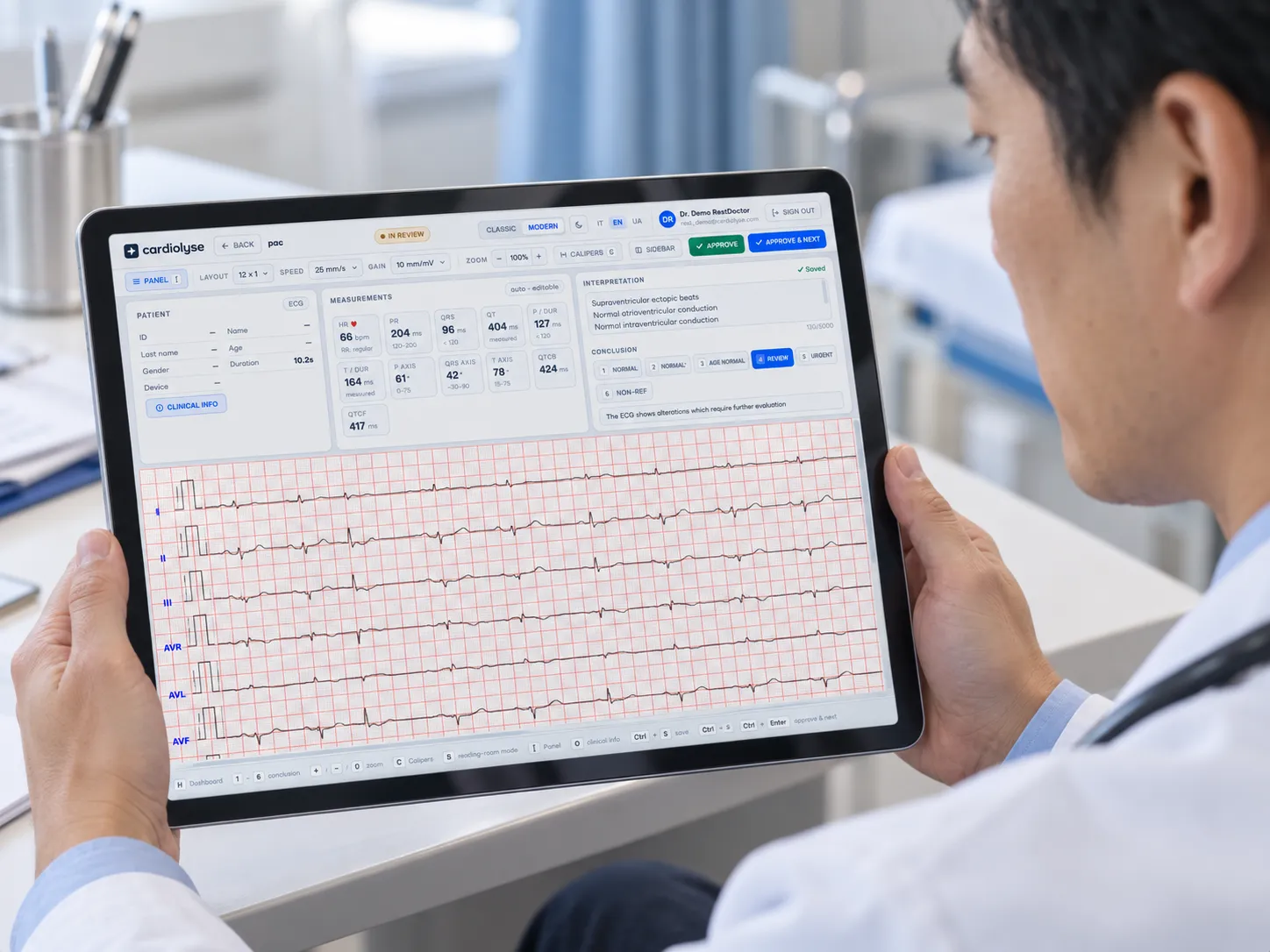
Cardiolyse gives sponsors, CROs and academic research groups a certified, device-neutral ECG AI engine — for centralised ECG reading, cardiac safety monitoring, QT prolongation surveillance and digital-biomarker discovery. Standardised, auditable, and fast enough to keep pace with modern decentralised trial designs.

Whether you're screening participants, tracking cardiac safety through Phase I to IV, or mining historical ECG datasets for digital biomarkers, Cardiolyse plugs into your existing trial infrastructure — no proprietary hardware, no lock-in.
Modern trials mix on-site 12-lead ECGs with home-based wearable recordings. Cardiolyse ingests all of them, harmonises the reads and delivers one auditable dataset back to your sponsor, CRO and statistical team.
Replace or augment traditional core-lab overreads with AI-assisted interpretation. Turnaround measured in minutes, not weeks, with full cardiologist sign-off available where the protocol requires it.
Enable at-home participation with any 1- to 12-lead wearable, patch or consumer ECG device. Cardiolyse harmonises the reads with in-clinic 12-lead data, so your endpoints stay comparable across visit types.

Accelerate participant enrolment with rapid, standardized ECG-based screening — QT prolongation, arrhythmia burden and eligibility flags in minutes.
Continuous or scheduled ECG capture across visits, with AI first-read and cardiologist adjudication where the protocol requires it.
Up to 300 vital ECG parameters, HRV metrics and Personal Baseline Scores per participant — exported to your biostats stack.
Deliver clean, auditable, regulator-ready cardiac-safety and endpoint data at every DSMB and at final lock.
Cardiolyse has been used in real programmes — from EU-funded rural care procurement to hospital telemonitoring pilots — with named academic and clinical partners.


Yes. Cardiolyse can act as the centralised ECG interpretation layer across all sites — with AI first-reads, cardiologist adjudication for regulated endpoints, full audit trails and structured data exports for your biostats team. We can operate as a standalone core lab or in partnership with your existing CRO.
The algorithm performs automated QT and QTc measurement (Bazett and Fridericia corrections) on 1- to 12-lead recordings, with quality-of-signal scoring and per-lead measurements. Alerts can be configured for protocol-defined QTc thresholds, and cardiologist adjudication is available where the study requires it.
Phase I healthy-volunteer through Phase IV real-world. Site-based, hybrid and fully decentralised designs. Any lead count from 1 to 12, any recording duration from a 10-second resting ECG to a multi-day Holter or continuous patch.
The analysis engine is CE-marked Class IIa medical device software under EU Regulations, operating under an ISO 13485 QMS. For regulated primary endpoints we recommend a hybrid workflow — AI first-read plus cardiologist adjudication — which we can deliver through the Cardiolyse network of reading cardiologists.
Any 1- to 12-lead digital ECG. Supported formats include XML, SCP-ECG, DICOM-ECG, PDF and common proprietary vendor exports. Wearables, patches, Holters and 12-lead diagnostic ECG carts are all supported — the analysis output is harmonised so cross-device comparison stays clean.
All processing happens in EU data centres, encrypted in transit and at rest, under a signed Data Processing Agreement. Cardiolyse is ISO 27001-aligned, GDPR-compliant and certified by NHS Digital for Data Security and Protection compliance, and can operate on pseudonymised or fully anonymised datasets.
Yes. Retrospective ECG datasets — for biomarker discovery, algorithm benchmarking or observational research — can be processed under a research licence. We provide the structured measurement export required for downstream statistical modelling.