ECG API & Integration

One REST API for ECG analytics.

No extra recording and no extra hardware. From the ECG you already capture, Cardiolyse derives more than 30 heart rate variability metrics, ECG codes and scores — from autonomic balance and stress to Heart Biological Age.

29
Documented API endpoints
10
+
ECG and RR-interval input formats
1–12 leads
From single-lead wearables to 12-lead ECG
300
ECG parameters available through the API

Everything from upload to report, in one interface.

Upload recordings, follow their processing, and pull back results, signals and reports in the format your product needs.

ECG upload
Send a recording and receive the analysis in the same call, or upload asynchronously and check its processing status for longer recordings.
RR-interval (HRV) upload
Devices that only record beat-to-beat intervals can send RR intervals as JSON or CSV for HRV analysis.
Results and parameters
Retrieve a summary or the full analysis, or request only the parameters you need — each with its measured and normalised value.
Reports
12-lead resting ECG and short reports in PDF; detailed reports and Holter reports in JSON or PDF — per recording or combined.
Signals and annotations
Download the raw file, raw signal or QRS signal, read beat annotations and send corrected annotations back.
Patients and records
Create patients, link recordings to them, tag records with your own external and device IDs, add comments and delete records.

From file to result in three calls.

Every request is authenticated with your API key in the X-Api-Key header. Short recordings can return results in one call; longer ones are uploaded asynchronously.

01
POST /upload/ecg/async
Upload
Send the ECG file with its file type. Add a patient, external ID or device ID if you need them.
02
GET /{recordId}/progress
Check status
Follow the processing status of the record until the analysis is ready.
03
GET /{recordId}/details
Get results
Retrieve the structured analysis, or a PDF or Excel report for the same record.

Works with the formats you already have.

Device files and generic signal formats go in; structured data and ready-made reports come out.

ECG files & RR intervals
EDF and DICOM-ECG
Device formats such as Mortara
Binary, CSV and JSON signals with sample rate and resolution
RR intervals
Structured JSON
Measured and normalised value per parameter
PDF reports and Excel detailed reports
Raw, raw-signal and QRS-signal downloads
Beat annotations, also as a text file
HTTPS & API key
HTTPS-only API
API-key authentication on every request
EU-hosted managed service
ISO 27001-aligned, GDPR & HIPAA-aligned

From first call to live product.

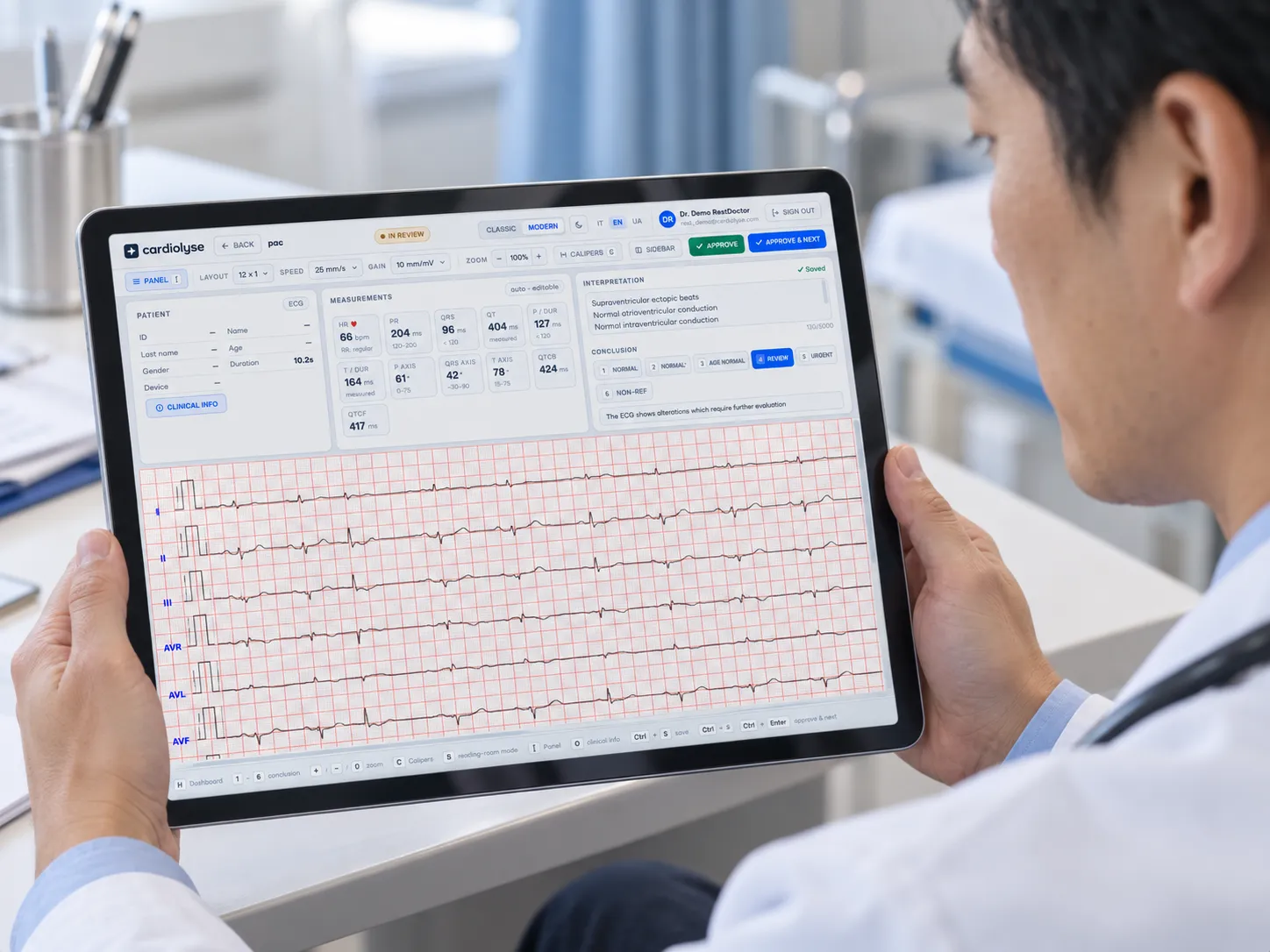
Doctor holding a tablet displaying an ECG report with heart rate and measurements, showing detailed heart activity with red gridlines and interpretation notes on the screen.
04
03
02
01

Scope

We look at your devices, file formats, lead count and the results your product needs to show.

Access

You receive an API key and start with the public documentation and your own sample recordings.

Build

Your team connects upload, status and results, with our engineers on hand for questions.

Go live

Results appear in your platform, under your brand, with the reports and parameters you selected.

Built for teams that ship ECG products.

ECG devices, patches and wearables
Add AI analysis and reports to your device through one API, under your brand.
Telehealth and remote monitoring
Analyse ECGs recorded at home or in the clinic and show structured results in your own app.
Studies and data teams
Process recordings in batches and export the parameters you need for your dataset.

ECG API and integration, answered.

Is the API documentation public?

Yes. The full reference, with endpoints, parameters and example requests, is available at api.cardiolyse.com/docs. An API key is needed to send requests.

Which file formats can we upload?

EDF, DICOM-ECG and device formats such as Mortara and DHeart, plus binary, CSV and JSON signals with their sample rate, resolution and lead count. RR intervals can be sent as JSON or CSV. If your device uses another format, tell us about it.

Should we use synchronous or asynchronous upload?

Synchronous upload returns the analysis in the same call and suits short recordings. For longer recordings, upload asynchronously and check the record’s processing status before fetching results.

Can we choose which results we receive?

Yes. You can request only selected parameters, retrieve a summary or the full analysis, and download PDF or Excel reports for the same record.

Do you support HL7 or FHIR?

The API returns structured, standards-compliant JSON that maps into clinical systems. Additional standards-based output formats can be discussed for your integration.

Can we test the API before committing?

Yes. We can set up evaluation access so you can run your own anonymised recordings. Contact us to get started.